












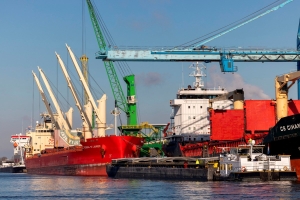
(Posted on 18/01/24)
In 2023, companies based in North Sea Port recorded a volume of 65.9 million tons of seaborne cargo throughput. That is a fall of 11%, or 7.8 million tons of goods, compared to the record year 2022. For inland waterway transhipment, the impact remained more limited.
The year 2022 was the best year ever, on the one hand due to growth and on the other due to the building of additional stocks in the light of exceptional geopolitical and economic conditions such as the Ukraine-Russia war and the energy crisis. It was therefore a near certainty that cargo transhipment would fall in 2023.
North Sea Port has traditionally been a bulk port; this remained true in 2023. However, the shares of both dry bulk and liquid bulk fell by 1%.
Dry bulk again accounted for more than half of cargo transhipment in 2023: 53% (35.2 million tons, -12% compared to 2022). The decline was seen mainly in coal (-27%). However, 2022 was a very exceptional year due to imports of additional stocks following EU sanctions on Russian coal after August 2022. Iron ore, gypsum, cement, wood pellets and natural fertilisers also fell.
Liquid bulk accounted for a share of 23% (15.1 million tons, -14%). Declines were recorded in liquid petroleum fuels (biodiesel and diesel) and naphtha.
The share of breakbulk was 15% (9.6 million tons, -5%). The transhipment of cellulose, in particular, declined.
It is notable that the share of containers in total cargo throughput has remained consistent since 2019 at 3% (2.2 million tons, -6%).
The roll on/roll off (ro/ro) segment saw a slight increase, accounting for 6% of total maritime transhipment (3.8 million tons, +1%).
Expressed by commodity type, there was no change in the transhipment of food products, metal industry products, vehicles and machinery. Declines were recorded in solid fuels (-22%, including coal), chemicals (-18%), agricultural products (-15%), crude minerals/construction materials (-12%), petroleum products (-10%) and fertilisers (-5%).
As in 2022, the United States was the port's most important trading partner (5.4 million tons). Although trade with the country declined by 13%, it had grown by more than a quarter in 2022. Great Britain occupied second place (4.7 million tons, -9%) and Brazil third (4.5 million tons, -8%), followed by Canada, Sweden, Russia, Norway, Finland, Australia and France.
As a result of EU sanctions, trade with Russia declined further by -42%, with the country dropping from second place to sixth. In 2022, trade with Ukraine had already halved; in 2023, it halved again.
Europe accounted for 56% of trade with North Sea Port (-1%), South America for 15% (+1%) and North America for 14% (-1%), with Africa at 7% (unchanged), Asia at 4% (unchanged) and Oceania also at 4% (+1%).
In 2023, the import-export ratio was 71%-29% (in 2022 it was 72-28%).
Daan Schalck, CEO North Sea Port: "After the bumper 2022, the impact of wars, the energy crisis and higher commodity prices has been leaving its mark for the past year. In the aftermath of the Brexit and the pandemic, cargo throughput bounced back unexpectedly strongly. Unfortunately this has not been the case with the current crises, at least so far."
In the first half of 2026, Port of Antwerp-Bruges handled 133.9 million tonnes of maritime cargo, a... Read more
PD Ports, one of the UK’s major port and logistics businesses, announced today that Paul Foreman... Read more
The Port of San Diego Board of Port Commissioners has approved an Option to Lease Agreement and authorised... Read more
AD Ports Group, an Abu Dhabi based, leading global enabler of integrated trade, industry and logistics... Read more
The Hamburg Port Authority (HPA) and SPG Qingdao Port Group have signed a Port Partnership Agreement... Read more
The Cook Labor Government in Australia has welcomed the award of a dredging contract to Jan De Nul ... Read more
A parliamentary letter in the Netherlands on the selection of a site for the construction of two new... Read more
The long-term safety cooperation between ESL Shipping and the port of SSAB’s Raahe site is visible... Read more
The Port of Liverpool is experiencing a surge in demand from fertiliser importers as continued uncertainty... Read more
PD Ports has further strengthened its bulk handling capability at Teesport with the arrival of... Read more