









(Posted on 24/02/23)
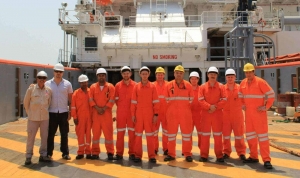
Ukrainian seafarers have largely returned to international shipping thereby restoring balance in crew availability, reports Danica Crewing Specialists on the anniversary of the war in Ukraine which impacted crewing rotations and seafarer welfare on a huge scale.
Demonstrating their resilience in the face of horrendous adversity, Ukrainian seafarers and their families are now mostly based in other European countries, and many are cutting short their shore leave time, meaning crew levels are now back to where they were before the Russian invasion.
Henrik Jensen, CEO of Danica Crewing Specialists, outlined how the crewing situation has evolved over the past year: “When the war broke out about 60% of Ukrainian seafarers were onboard merchant ships. A few wanted to return home immediately but the majority stayed onboard and when their tenure came to the planned end, providing their families were safe, they asked to stay longer to guarantee an income.
“Over the summer this situation changed as seafarers were reunited with their families who had fled to other countries, and at this point many of them extended their shore leave breaks, creating a brief shortage of relievers.
“However, the situation has now changed again and since the autumn we have seen a balance establish between supply and demand for Ukrainian seafarers.”
Mr Jensen explained that the costs of re-establishing family life from scratch in a new country, coupled with the increased cost of living in EU countries and the UK, means Ukrainian seafarers now seek to return to paid work at sea sooner.
“Previously most Ukrainian senior officers were on a four months on/off rotation, but now they are more likely to serve five months onboard and only two months at home, and these patterns are similar for other ranks too. The result of this is that each seafarer spends more time at sea and therefore this has compensated for any seafarers who are still not able to leave Ukraine. I anticipate that this crewing pattern will remain in place for some time to come,” he said.
According to the most recent ICS/BIMCO Seafarer Workforce Report, Ukraine tops the list of countries identified as most likely to supply seafarers in the future. It is a country with a long maritime history – seafaring is a tradition in Ukraine and there are even senior officers who are the third-generation sailors in their family.
Ukraine’s seafarers have undergone a traumatic time. One year on from the Russian invasion of Ukraine some seafarers have begun to talk about their experiences. Speaking to Danica Crewing Specialists three of these seafarers recalled what happened when the tanks rolled in and missiles landed in their home country.
For those at sea this meant days of fear and worry about their families at home caught up in the conflict, while those on shore leave within Ukraine experienced the terror and deprivation of war.
A 40-year-old Bulk Carrier Master revealed how he was at sea when the invasion happened and his pregnant wife and two young children were in Mariupol. He recalled how he spent several terrifying days waiting to hear whether they were safe. When his brave wife eventually found a phone signal and spoke to him he disclosed: “I cannot really explain all that feeling when I heard her voice. I was on the bridge at the time and couldn’t stop my weeping, I was happy to know that she and all my family were still alive.” However, he added: “It was very terrible to hear during our conversation in the background the strong noise of bomb explosions and I told my wife to take all the family and try to escape when possible.”
The Captain told how the city of Mariupol had suffered “hard bombardment” which destroyed much of its infrastructure. He said, “All the markets were destroyed. They didn’t have electricity, or heating – and outside was minus 15 degrees! To get water they needed to go outside and take it from a source.”
His wife and children made the perilous journey across Ukraine and into Bulgaria where his baby daughter was born. Unfortunately, the Captain’s parents were at first reluctant to leave their home and communication was lost with them for a while. He described how he tried to get news of them via social media channels, finally finding out from an online friend that they had made it to another city. He described how they called him several hours later to tearfully explain their experience, which he described as “like a scare movie”. Two bombs had landed near their house and his mother was trapped under rubble. His father was knocked unconscious, eventually coming to and pulling his injured wife free. They joined his wife in Romania where, thanks to fundraising efforts by Romanian people, his mother was able to have surgery on her injured leg enabling her to walk again – this being early in the conflict when the Captain was unable to transfer funds.
The Maritime Association for Clean Seas (MACS) has published a series of practical guides to enable... Read more
Shanghai has officially become the world’s second-most prominent shipping hub, according to the... Read more
OceanScore, the maritime data and sustainability company helping shipping and ports turn regulatory... Read more
Bulk carrier safety continues to show steady long-term improvement, but the nature of risk facing seafarers... Read more
Following stronger than expected operational performance in dry cargo, reduced costs associated with... Read more
Algoma Central Corporation, a leading provider of marine transportation services, has announced that... Read more
Major maritime, ports and energy companies have been identified by Cydome’s threat-intelligence... Read more
As the global shipping industry faces mounting concerns over future crew availability, Danica Crewing... Read more
Following an attack on a vessel in the Gulf of Oman, IMO has decided to temporarily pause its evacuation... Read more
Leading health and wellness platform OneCare Group is calling on shipping leaders to recognise the immense... Read more