








(Posted on 03/10/19)
The United States and Japan has announced a limited trade deal that includes Japan opening its markets to more than $7 billion in U.S. agricultural products.
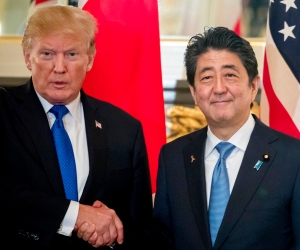
President Donald Trump and Japanese Prime Minister Shinz? Abe announced the agreement during a meeting on the sidelines of the United Nations General Assembly meeting in New York.
“Japanese tariffs will now be significantly lower or eliminated completely on beef, pork, wheat, cheese, corn, wine and so much more,” Trump told reporters in New York.
Trump notified Congress last week that the U.S. and Japan were prepared to enter a limited agreement that would lower some tariffs and set terms of digital trade.
Under the agreement announced this week, Japan will eliminate or reduce tariffs on an additional $7.2 billion of U.S. food and agricultural products, according to a fact sheet issued by the White House. The document said out of the $14.1 billion in U.S. food and agricultural products imported by Japan in 2018, $5.2 billion were already duty free. The fact sheet did not list tariff figures for specific U.S. agricultural commodities; but they are believed to be equivalent — with the exception of rice and a portion of dairy products — to those granted by Japan to other countries under the former Trans Pacific Partnership trade agreement from which President Trump withdrew the United States during the first year of his presidency.
“Once this agreement is implemented, over 90 percent of U.S. food and agricultural products imported into Japan will either be duty free or receive preferential tariff access,” the White House noted.
Once implemented, Japan agreed it will reduce tariffs in varying stages for beef and pork. Tariffs will be eliminated immediately on over $1.3 billion worth of several types of produce and grain sorghum.
Japan’s effective tariff on imported U.S. wheat will drop to the same level as Canadian and Australian wheat imports. This is particularly important considering the Comprehensive and Progressive Trans-Pacific Partnership (CPTPP) agreement – the successor to TPP entered into between Australia, Brunei, Chile, Japan, Malaysia, Mexico, New Zealand, Peru, Singapore and Vietnam – would make U.S. wheat imports less cost-competitive compared to other CPTPP countries without a separate U.S.-Japan agreement. In addition to matching the Canadian and Australian tariff schedule for U.S. wheat, Japan agreed to open country specific quotas for U.S. wheat and wheat product imports; but those specific numbers were not contained in the materials issued by the White House this week.
According to U.S. Wheat Associates, U.S. wheat represents about 50 percent of all the wheat Japan imports each year, currently valued at more than $600 million annually.
A Trump administration official noted during a Sept. 25 conference call: “When this agreement enters into force, we will immediately match and have the same tariff treatment as is the case with Canada, Australia, New Zealand, etc.”
In a press statement, U.S. Secretary of Agriculture Sonny Perdue said the agreement “helps level the playing field” between the U.S. and Japan and “is a particularly big win for our farmers and ranchers.”
Rio Tinto has driven performance to achieve 3% YoY CuEq1 growth in the first half of 2026.Chief Executive... Read more
BHP have released its Operational Review for the year ended 30 June 2026.Chief Executive Officer, Brandon... Read more
Bulk carriers carrying elemental sulphur cargoes in the Strait of Hormuz are at significant risk of... Read more
Further to BHP’s announcement in February, BHP, through a wholly owned subsidiary, has executed... Read more
Australia’s Federal Government's fertiliser support package has come under scrutiny as global... Read more
SSAB has once again paused work at the construction site for its new steel mill in Luleå, Sweden... Read more
Trafigura Group Pte Ltd. has announced the issuance of a USD500 million senior Reg S bond with a five... Read more
The National Grain and Feed Association (NGFA) in the USA has welcomed the release of Senate Agriculture... Read more
Anglo American plc, through its 50.1%-owned subsidiary, Anglo American Sur S.A., and Codelco, have announced... Read more
SSAB Americas, The Greenbrier Companies and Alter Trading are partnering on a circular economy project... Read more