








(Posted on 29/01/26)
For the second consecutive year, and despite an economic climate that remains challenging, the port of Dunkirk has recorded a 5% increase in maritime activity, reaching 48 million tonnes (MT).
This represents the strongest growth recorded among the major ports on the North European range.
Dry bulk fell by 5% to 14.3 MT (30% of total activity).
Ore traffic rose slightly by 1% to 7.8 MT. The technical shutdown of blast furnace No. 4 (HF4) at the Dunkirk steelworks, which lasted more than three months, weighed on this sector. However, the good level of iron ore transhipment to Bremen at Port Ouest helped to keep flows stable overall. Meanwhile, coal import volumes continued their structural decline, falling 10% to 2.7 million tonnes.
At the same time, grain activity showed a slight increase of 1% to 1.3 MT. The very poor grain harvest in 2024 weighed heavily on activity in the first half of the year, although exports in the second half of the year picked up following a very favourable harvest in 2025, both in terms of quantity and quality.
General cargo increased by 4% to 19.3 million tonnes (40% of total activity). Liquid bulk posted a marked increase of 18% to 14.4 MT (30% of activity).
With a total volume exceeding 10 MT in 2025, the Dunkirk LNG terminal surpassed its previous record set in 2022 (9.7 MT) and confirmed Dunkirk's role as a major gas hub in Western Europe.
Container traffic at the port rose by 14% to 747 KTEUs, equalling the historic record set in 2022.
In October 2025, NORD CÉRÉALES commissioned eight new storage cells with a total capacity of 30,000 tonnes, bringing the terminal's total capacity to 330,000 tonnes. This expansion enhances the agri-food hub's logistical appeal and its ability to absorb growing volumes.
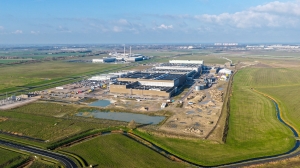
At its annual press conference on 20 January at the Cité des Échanges in Marcq-en-Barœul, Dunkerque-Port announced the winners of the Call for Expressions of Interest (CEI) it had launched to revitalise part of the brownfield site of the former SRD refinery. The selected projects are jointly led by Technip Energies, a leading technology and engineering company and leader in energy and decarbonisation infrastructure, and Tepsa, an independent operator specialising in the storage of bulk liquids such as chemicals, agrochemicals, biofuels and fuels that are essential to the economy.
In line with this approach of pooling resources and industrial optimisation, and subject to the final investment decision, Technip Energies will build and operate a sustainable aviation fuel (SAF) production unit using second-generation ethanol.
Tepsa will build and operate a new import-export terminal for liquid bulk, handle all of Technip Energies' maritime logistics, and complete its project with import and storage capacities for liquid bulk dedicated to the battery manufacturing and recycling sector and other energy transition sectors.
In the first half of 2026, Port of Antwerp-Bruges handled 133.9 million tonnes of maritime cargo, a... Read more
PD Ports, one of the UK’s major port and logistics businesses, announced today that Paul Foreman... Read more
The Port of San Diego Board of Port Commissioners has approved an Option to Lease Agreement and authorised... Read more
AD Ports Group, an Abu Dhabi based, leading global enabler of integrated trade, industry and logistics... Read more
The Hamburg Port Authority (HPA) and SPG Qingdao Port Group have signed a Port Partnership Agreement... Read more
The Cook Labor Government in Australia has welcomed the award of a dredging contract to Jan De Nul ... Read more
A parliamentary letter in the Netherlands on the selection of a site for the construction of two new... Read more
The long-term safety cooperation between ESL Shipping and the port of SSAB’s Raahe site is visible... Read more
The Port of Liverpool is experiencing a surge in demand from fertiliser importers as continued uncertainty... Read more
PD Ports has further strengthened its bulk handling capability at Teesport with the arrival of... Read more