





(Posted on 22/06/26)
The Port of Liverpool is experiencing a surge in demand from fertiliser importers as continued uncertainty surrounding global trade routes prompts companies to reassess their UK logistics strategies.
Enquiries to Peel Ports Group about fertiliser imports have increased by more than two hundred percent as customers review how product is brought into the UK. Despite renewed hopes of a peace deal, concerns over disruption to international shipping routes remain, including the unpredictable situation around the Strait of Hormuz.
Peel Ports Group is the UK’s second largest port operator, owning and operating six of the UK’s most important ports (Liverpool, Heysham, Manchester Ship Canal, Medway (Sheerness / Chatham), Clydeport and Great Yarmouth).
Although the majority of fertilisers are typically imported through ports on the UK’s east coast, the current supply chain disruption has led importers to explore alternative UK locations.
As part of this review, customers are now looking to deploy larger ships to improve cost efficiency, secure product when it becomes available and reduce exposure to potential disruption elsewhere in the supply chain. Liverpool’s capacity for deep-sea vessels, and its position on the west rather than east coast, is driving interest to the port.
There is also driving greater demand for warehousing capacity across the North West for stockpiling as a hedge against further disruption or even a complete loss of supply.
Phil Hall, Port Director Liverpool at Peel Ports Group said: "Customers are looking closely at how they can strengthen resilience across their supply chains. For many, that means reviewing vessel choice, storage capacity and alternative ports to ensure they can continue to move product efficiently despite ongoing uncertainty in global markets.
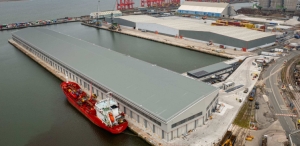
“We have invested millions in facilities such as the recently developed Alexander Warehouse. Although we took the decision well before the situation in Iran, that speculative move does mean we are now ready to support this market as interest increases for immediate solutions that can support fertiliser imports and provide greater supply chain flexibility.”
The UK fertiliser market relies heavily on imported products including urea, ammonium nitrate and phosphates. As a result, importers are placing greater emphasis on infrastructure that can support efficient discharge, storage and distribution of cargoes once they arrive in the country.
Peel Ports handles approximately 70 million tonnes of cargo every year. 14% of the total UK major ports traffic flows through ports operated by the Group.
PD Ports has further strengthened its bulk handling capability at Teesport with the arrival of... Read more
Enstructure, one of North America’s leading terminal and logistics companies, has announced that... Read more
The Duluth Seaway Port Authority and its terminal operations on Rice’s Point once again ranked... Read more
AV Dawson, owner and operator of the Port of Middlesbrough in the UK, has strengthened its position... Read more
The port of Rotterdam has formed the setting for a significant milestone in the development of autonomous... Read more
The Board of Directors of Port of Antwerp-Bruges has appointed Rob Smeets as CEO of the Antwerp-Bruges... Read more
Abu Dhabi based AD Ports Group, a leading global enabler of trade, industry, and logistics solutions... Read more
The aim is to foster the multimodal logistics services that the Port of Bilbao companies offer to trade... Read more
Hamburg’s Senator for Economic Affairs, Dr Melanie Leonhard, has welcomed Estonia’s Minister... Read more
Associated British Ports (ABP), the UK’s largest port operator and one of the UK’s biggest... Read more