







(Posted on 18/10/23)
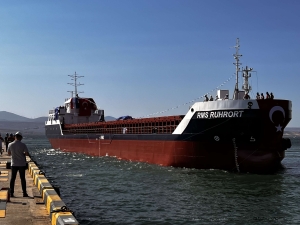
Rhenus Maritime Services (RMS) is adding a new coastal vessel to its fleet in the shape of the RMS Ruhrort. It has a special feature: the engine on board the RMS Ruhrort is equipped in such a way that it can use methanol as its fuel in future. Methanol is viewed as an environmentally- and climate-friendly fuel of the future for shipping, in addition to hydrogen and ammonia. However, until that time arrives, the RMS Ruhrort will operate using a diesel engine and it is therefore already equipped to fulfil the latest technical standards in order to meet both current and future CO2 benchmarks.
The RMS Ruhrort has a payload capacity of 2,950 DWAT and will exclusively transport dry goods such as steel coils or wheat.
Rhenus purchased the RMS Ruhrort as a shell construction from a Romanian shipyard after a Norwegian shipping company placed an order for the hull, but it was not completed. Rhenus transferred the vessel to a Turkish shipyard, where it is currently being fitted out by Handelskade Shipsales BV from Dordrecht, which is acting as the general agent. “The hull fits perfectly into the portfolio of our current fleet. It has dimensions, which have rarely been used any more when constructing European coastal vessels during the last few years. Vessels of this design and size are normally more than 20 years old and technically out of date. It’s true that we can no longer change anything in terms of the steel hull, but we can make use of a low-emission drive system and the latest digital technology on the bridge during the fitting work so that the RMS Ruhrort is ideally equipped to face the future,” says Ralf Uebachs, the Managing Director of Rhenus Maritime Services.
Rhenus has decided to use a low-emission, Mitsubishi eight-cylinder diesel engine that is ‘methanol-ready’. “If the world of shipping agrees to use an alternative fuel, the motor can be re-equipped to become an almost climate-neutral ‘methanol engine’ without a great deal of effort or expenditure. In order to already cut emissions at this time, we’ve reduced the performance of the diesel engine from a standard figure of 1,350 kW to 1,100 kW. It’s completely satisfactory to travel at a speed of 10.5 knots rather than 12 knots,” says Menno van der Plas from Handelskade Shipsales BV, explaining this feature.
In order to make the RMS Ruhrort as ecologically-friendly as possible in addition to this, a nozzle has been installed around the vessel’s propellor and a particular colour of paint has been used on the outside, which reduces resistance when the vessel is moving. Both of these measures save fuel and significantly reduce the CO2 emissions. Other environmentally-friendly features include an SCR catalytic converter, which prevents nitrogen emissions, and a system for processing ballast water in order to protect marine flora and fauna from contaminating organisms. The vessel also meets the more stringent requirements of the Energy Efficiency Design Index (EEDI) – a figure, which represents the specific CO2 emissions of cargo vessels.
Once the RMS Ruhrort has been finished, it will be possible to deploy the vessel anywhere in the world. It has a particular advantage: thanks to its fairly compact design, it can be used for so-called niche market shipping – on the river Rhine, for example. However, before that can take place, it is first necessary to complete the sea trials during the middle of October and they thoroughly test the seaworthiness of the hull and certify the vessel to complete journeys at sea.
CM Technologies (CMT) has supplied its integrated onboard fuel/oil testing and analysis kits to a fleet... Read more
Superior Industries, Inc., a U.S.-based manufacturer and global supplier of bulk material processing... Read more
NDE Readymix Concrete Ltd., established in 2009, is the largest non-cement ready-mix concrete producer... Read more
German corrosion protection specialist Steelpaint has successfully completed a technical field trial... Read more
Veson Nautical has announced the Veson Platform, a unified, AI-powered experience that brings together... Read more
ABB has announced that it has entered into an agreement to acquire marine automation specialist Hø... Read more
NAVTOR has unveiled the latest iteration of its Digital Logbooks offering, featuring the industry&rsquo... Read more
The maritime industry is facing a rapidly changing fire risk on board vessels as electric vehicles and... Read more
Smart Ship Hub (SSH), the maritime intelligence and data collection platform, has launched one of the... Read more
World leading manufacturer of rope operated mechanical grabs for the dry bulk industry, Verstegen Grijpers... Read more