




(Posted on 03/04/25)
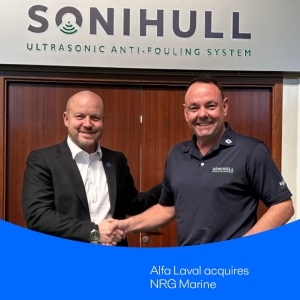
Alfa Laval has completed the acquisition of UK-based NRG Marine, a leading provider of ultrasonic anti-fouling technology for marine, oil-and-gas and industrial applications. This strategic move strengthens Alfa Laval’s capabilities toward enhancing energy efficiency and operational performance while reducing costs and extending asset lifespan.
Rising energy costs, CII improvement and evolving regulations are accelerating the shift toward future-proof, eco-friendly innovations that optimize operations, support decarbonisation and reduce environmental impact. Ultrasonic anti-fouling technology is one such immediate opportunity for industries to improve their operations sustainably.
This move strengthens Alfa Laval’s position as a provider of next-generation solutions for multiple sectors. With the addition of ultrasonic anti-fouling technology, Alfa Laval will enable its customers to benefit from solutions that prevent organic matter buildup on the surface of critical assets in a sustainable way, thereby increasing equipment efficiency.
"This acquisition is a strategic step towards offering solutions that enhance operational efficiency and minimise environmental footprint, supporting industry’s net-zero objectives,” says Sameer Kalra, President, Marine Division, Alfa Laval. “By integrating ultrasonic anti-fouling technology into our portfolio, we aim to expand its reach and impact, empowering customers across marine, oil and gas, and industrial sectors with greater energy optimization and performance improvements.”
NRG Marine, recognised for its Sonihull and Agitate brands, prevents organic deposit buildup by using imploding microscopic bubbles to create surface agitation, passively cleaning surfaces and preventing biofouling of critical components.
Installing the system improves the equipment's performance and lifespan, reduces system downtime, and lowers maintenance and cleaning costs. The system’s low cost compared to the value gained from reduced fouling and improved maintenance cycles offers attractive returns on investment for all sectors.
In addition to the operational benefits, anti-fouling systems play an important role in reducing fuel consumption and improving vessel CII in the maritime industry. They also mitigate the risk of spreading invasive species, further supporting sustainability efforts and other environmental metrics.
The system provides reliable, low-maintenance biofouling prevention, critical for enhancing uptime and minimizing operational risks in industrial operations. It ensures the uninterrupted cleanliness of internal pipes and valves, keeping operations running smoothly without downtime.
In the oil and gas sector, this system prevents biofouling on stationary surfaces. Being ATEX-approved, it complies with required safety standards, ensuring reliability and safety.
The ultrasonic anti-fouling technology offers a chemical-free, energy-efficient alternative to traditional anti-fouling approaches, making it a sustainable choice for businesses looking to protect the environment with green technology.
In recent years, Alfa Laval has strategically expanded its portfolio through key acquisitions to meet market demands for energy efficiency and decarbonization with high-impact solutions.
CM Technologies (CMT) has supplied its integrated onboard fuel/oil testing and analysis kits to a fleet... Read more
Superior Industries, Inc., a U.S.-based manufacturer and global supplier of bulk material processing... Read more
NDE Readymix Concrete Ltd., established in 2009, is the largest non-cement ready-mix concrete producer... Read more
German corrosion protection specialist Steelpaint has successfully completed a technical field trial... Read more
Veson Nautical has announced the Veson Platform, a unified, AI-powered experience that brings together... Read more
ABB has announced that it has entered into an agreement to acquire marine automation specialist Hø... Read more
NAVTOR has unveiled the latest iteration of its Digital Logbooks offering, featuring the industry&rsquo... Read more
The maritime industry is facing a rapidly changing fire risk on board vessels as electric vehicles and... Read more
Smart Ship Hub (SSH), the maritime intelligence and data collection platform, has launched one of the... Read more
World leading manufacturer of rope operated mechanical grabs for the dry bulk industry, Verstegen Grijpers... Read more