




(Posted on 25/05/26)
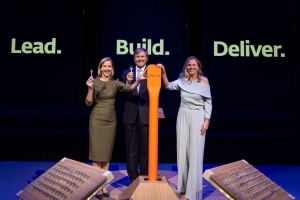
King Willem-Alexander of the Netherlands has symbolically activated the first section of the national hydrogen network in Rotterdam. He was joined by Minister Stientje van Veldhoven of Climate Policy and Green Growth and Gasunie CEO Willemien Terpstra to mark the official completion of the first route in the Rotterdam port area: a 32-kilometre pipeline linking the Maasvlakte and Pernis. This represents a significant milestone in the development of Dutch and European hydrogen infrastructure.
As the largest dry bulk port in Europe, the port of Rotterdam has all the facilities required for the storage and transhipment of dry bulk cargo.
The construction of the national hydrogen network commenced in October 2023. With the completion of this first route, hydrogen can now be transported from production locations on the Maasvlakte to industry. Over the coming years, the network will be further expanded to major industrial regions across the Netherlands and connected to storage locations and networks in Germany and Belgium.
The completion of the first section in Rotterdam marks a significant step in making industry more sustainable while maintaining its competitiveness. With the port of Rotterdam as a European energy hub and the strategic connection along the Delta Rhine Corridor, hydrogen and CO2 can be transported between the Netherlands and Germany. This infrastructure therefore constitutes an essential building block for an integrated European energy system. Within this system, hydrogen, CO2, natural gas, heat and wind energy will collectively strengthen the strategic autonomy and economic earning capacity of the Netherlands and Northwestern Europe.
The national hydrogen network will eventually extend over approximately 1,200 kilometres, largely using existing natural gas pipelines. The network therefore forms an essential precondition for the development of a well-functioning hydrogen market and for improving the sustainability of industry. The first hydrogen plant has now also been connected to the network. Additional production and import locations, as well as industrial clients are expected to be connected to the Rotterdam network in the coming years.
Rotterdam’s position as Europe’s largest dry bulk port, is in part due to the ‘raw materials transition’, whereby for example, waste flows and biomass are being used as sustainable raw materials as an alternative to fossil fuels for fuel production and in the chemical industry.
In the first half of 2026, Port of Antwerp-Bruges handled 133.9 million tonnes of maritime cargo, a... Read more
PD Ports, one of the UK’s major port and logistics businesses, announced today that Paul Foreman... Read more
The Port of San Diego Board of Port Commissioners has approved an Option to Lease Agreement and authorised... Read more
AD Ports Group, an Abu Dhabi based, leading global enabler of integrated trade, industry and logistics... Read more
The Hamburg Port Authority (HPA) and SPG Qingdao Port Group have signed a Port Partnership Agreement... Read more
The Cook Labor Government in Australia has welcomed the award of a dredging contract to Jan De Nul ... Read more
A parliamentary letter in the Netherlands on the selection of a site for the construction of two new... Read more
The long-term safety cooperation between ESL Shipping and the port of SSAB’s Raahe site is visible... Read more
The Port of Liverpool is experiencing a surge in demand from fertiliser importers as continued uncertainty... Read more
PD Ports has further strengthened its bulk handling capability at Teesport with the arrival of... Read more