









(Posted on 01/04/26)
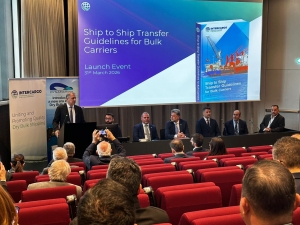
The International Association of Dry Cargo Shipowners (INTERCARGO) brought shipowners, charterers, insurers and service providers together in Athens on 31 March to tackle a growing issue in dry bulk shipping: how ship-to-ship (STS) transfers are actually carried out.
INTERCARGO unites and promotes quality dry bulk shipping, bringing together more than 450 forward thinking companies operating over 4600 bulk carriers, from more than 35 countries.
STS in dry bulk is no longer occasional. It is becoming part of day-to-day operations as larger vessels and limited port infrastructure force cargo to be moved offshore.
Yet the sector has reached this point without a clear, shared way of performing STS safely and efficiently.
In tanker shipping, STS follows established practices for over twenty years. Dry bulk has taken a different path, shaped by cargo type, local conditions and the realities of each trade.
The session opened with remarks from INTERCARGO Chairman John Xylas, followed by a detailed presentation by INTERCARGO Technical Committee Chair Dimitris Monioudis and contributions from NYK Group, DYNAMARINe, Britannia P&I Club, James Fisher, Charterwell Maritime, Oldendorff Carriers and Maran Dry Management.
What came through was the complexity of the work itself. Multiple parties involved in each transfer. Resources that vary from region to region. Weather, draft restrictions and visibility that change the risk profile hour by hour. And procedures that are not always applied in the same way twice.
The discussion drew on INTERCARGO’s recently developed “Ship to Ship Transfer Guidelines for Bulk Carriers”, developed with input from its members across the industry, and a starting point for a more consistent approach.
Commenting after the event, John Xylas, Chairman of INTERCARGO said: “What this event showed clearly is that STS in dry bulk is no longer a niche activity. It is something the industry is already doing and doing more of.
Bringing together owners, charterers, insurers and service providers in one room is an important step towards a more aligned approach. As activity continues to grow, that alignment will be critical in shaping how these operations are carried out safely and consistently across the sector. We call on all stakeholders to engage and actively promote safer STS activities.”
Captain Panagiotis Nikiteas, HSQE Manager / DPA / CSO of Maran Dry Management, presenting at the event, said: “The new STS guidelines are important in promoting consistency in operations and reducing the risk of disruption.”
By convening stakeholders from across the maritime value chain, INTERCARGO aims to support a more joined-up approach to STS transfers, with wider engagement expected as the industry works towards greater consistency in how these activities are carried out.
The Maritime Association for Clean Seas (MACS) has published a series of practical guides to enable... Read more
Shanghai has officially become the world’s second-most prominent shipping hub, according to the... Read more
OceanScore, the maritime data and sustainability company helping shipping and ports turn regulatory... Read more
Bulk carrier safety continues to show steady long-term improvement, but the nature of risk facing seafarers... Read more
Following stronger than expected operational performance in dry cargo, reduced costs associated with... Read more
Algoma Central Corporation, a leading provider of marine transportation services, has announced that... Read more
Major maritime, ports and energy companies have been identified by Cydome’s threat-intelligence... Read more
As the global shipping industry faces mounting concerns over future crew availability, Danica Crewing... Read more
Following an attack on a vessel in the Gulf of Oman, IMO has decided to temporarily pause its evacuation... Read more
Leading health and wellness platform OneCare Group is calling on shipping leaders to recognise the immense... Read more