









(Posted on 14/05/18)
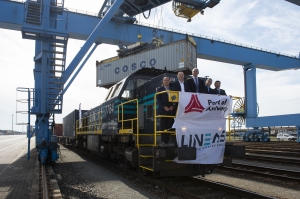
The first Silk Road train exclusively destined for Antwerp arrived on Saturday 12 May. The freight train, which had left the Chinese port of Tangshan on 26 April, was officially welcomed in the port of Antwerp. This direct railway link between China and Antwerp is part of the transnational Chinese ‘Belt and Road Initiative’, with which China seeks to revive the trade routes of the old Silk Road from Asia to Europe.
The train is part of the 'Belt & Road Initiative' (BRI), the ambitious development programme of Chinese President Xi Jinping. The initiative provides for enhanced Eurasian connectivity through major infrastructure projects and restoration of the Silk Road, the historic trade route between Europe and the Far East which, in addition to the traditional maritime link, an efficient land bridge link.
The train left the Chinese port of Tangshan on 26 April and travelled via the border crossing of Alashankou, Kazakhstan, Belarus, Poland and Germany to reach its final destination, the port of Antwerp, after 16 days and having covered a distance of 11,000 km. It is the fist ever direct train from China to Antwerp.
The service is an initiative of Tangshan City & Tangshan Port, in collaboration with the Chinese state-owned shipping company Cosco Shipping Lines and the Chinese Railways (CRCT).
The consignee is Cosco Shipping Belgium, which will ensure the forwarding to the end customers. The train is loaded with a total of 34 containers, containing industrial minerals for use in various industries and productions such as paper and ceramics, toothpaste and cosmetics. They are unloaded at Euroports, which will transport them to their bulk terminal for subsequent distribution in Europe.
Luc Arnouts, Director International Networks, Antwerp Port Authority said, “This direct train link puts our port on the BRI map and will further strengthen our ties with China. We have long been working on this project, which represents an important milestone in our trade relations with China."
Marc Van Peel, port alderman, adds: “China is the fourth biggest partner country for Antwerp, with an annual traffic volume of nearly 14 million tonnes of goods. Antwerp is ideally located on both the maritime route and the rail route between Europe and China, and our port is perfectly capable of acting as a transhipment port for trade between China and Africa via rail link.”
Geert Gekiere, Managing Director Euroports Belgium said, “We are proud and honoured to have the privilege of unloading and further handling the majority of the load of this first direct train between China and Antwerp. We encourage our customers to optimise their supply chain, which is why virtually all of our terminals support both road, rail and water connections. Transport from the Tangshan region via conventional container ships on average takes +35 days, but this train manages to do it in a record time of 16-20 days, and at relatively low costs."
In the first half of 2026, Port of Antwerp-Bruges handled 133.9 million tonnes of maritime cargo, a... Read more
PD Ports, one of the UK’s major port and logistics businesses, announced today that Paul Foreman... Read more
The Port of San Diego Board of Port Commissioners has approved an Option to Lease Agreement and authorised... Read more
AD Ports Group, an Abu Dhabi based, leading global enabler of integrated trade, industry and logistics... Read more
The Hamburg Port Authority (HPA) and SPG Qingdao Port Group have signed a Port Partnership Agreement... Read more
The Cook Labor Government in Australia has welcomed the award of a dredging contract to Jan De Nul ... Read more
A parliamentary letter in the Netherlands on the selection of a site for the construction of two new... Read more
The long-term safety cooperation between ESL Shipping and the port of SSAB’s Raahe site is visible... Read more
The Port of Liverpool is experiencing a surge in demand from fertiliser importers as continued uncertainty... Read more
PD Ports has further strengthened its bulk handling capability at Teesport with the arrival of... Read more