



(Posted on 02/09/21)
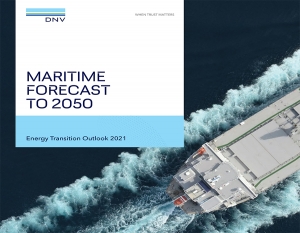
DNV, the world’s leading classification society, has launched its latest Maritime Forecast to 2050, part of the Energy Transition Outlook (ETO) suite of reports. Conceived to help shipowners navigate the technologies and fuels needed to meet global greenhouse gas (GHG) targets, the report features an updated carbon risk management framework, including a new ‘decarbonization stairway’ model to help owners map a path to sustainability.
The 80-page report aims to assist an industry facing the dual challenge of increasingly stringent climate change targets and regulations coupled with uncertainty over future fuel choices, technology, and supply.
It is, according to DNV Maritime CEO Knut Ørbeck-Nilssen, “the grand challenge of our time.”
“Choosing the right fuel today for operations tomorrow is a daunting task that all owners must face up to,” said Ørbeck-Nilssen. “The business environment is changing in line with the natural one, leading not just to increased regulatory requirements, but also to new cargo-owner and consumer expectations and more rigorous demands from capital investors and institutions.
“A misstep today in newbuild fuel strategies can have damaging consequences for businesses and assets in the future. So, owners need practical, expert advice and smart solutions to ensure vessels stay competitive, compliant and commercially attractive over their lifetimes. This is where the Maritime Forecast to 2050 can help turn strategic uncertainty into confident decision-making.”
The report maps the shifting regulatory landscape, provides a status update on technology and alternative fuels, and views the energy transition from a wider perspective – investigating the financing of green onboard investments, as well as the need for rapid development of supply-side capacity for new fuels.
To support shipowners, DNV provides an updated framework for managing carbon risk in newbuilding designs, a techno-economic evaluation of fuel strategies, and the vessel design implications of those chosen approaches. The ‘decarbonization stairway’ is introduced to show how individual owners can adapt to stay below the required GHG emission trajectories.
Linda Sigrid Hammer, DNV Maritime Principal Consultant and Maritime Forecast to 2050 report lead author, said: “With between 1,000 and 2,000 ships expected to be ordered annually through 2030, there’s a real need for informed decisions that consider a diverse array of factors; from cost, to fuel storage and propulsion, through to flexibility in design, strategic approach, and fuel ready solutions. And of course, all of this is underpinned by the need for safety.
“Our revised framework allows for detailed assessments, providing support and expertise to mitigate the risks and uncertainties facing owners. The carbon neutral destination for the industry is clear, but the pathway is not. This report will help owners chart their way forwards.”
The new Maritime Forecast to 2050 – the fifth edition of its kind – features detailed case studies to help evaluate fuel and technology scenarios and compare competing solutions. The report finds that the maritime energy transition is already gaining momentum, with around 12% of newbuilds currently ordered with alternative fuel systems. This is double the 6% revealed by DNV’s 2019 Maritime Forecast report. However, less than 1% of ships currently in operation use alternative fuels, with the huge majority plying short-sea routes.
DNV forecasts that total CAPEX for onboard technology investments required to satisfy IMO decarbonization ambitions will range from USD 250-800 billion (dependent on fleet size) between 2020 and 2050.
CM Technologies (CMT) has supplied its integrated onboard fuel/oil testing and analysis kits to a fleet... Read more
Superior Industries, Inc., a U.S.-based manufacturer and global supplier of bulk material processing... Read more
NDE Readymix Concrete Ltd., established in 2009, is the largest non-cement ready-mix concrete producer... Read more
German corrosion protection specialist Steelpaint has successfully completed a technical field trial... Read more
Veson Nautical has announced the Veson Platform, a unified, AI-powered experience that brings together... Read more
ABB has announced that it has entered into an agreement to acquire marine automation specialist Hø... Read more
NAVTOR has unveiled the latest iteration of its Digital Logbooks offering, featuring the industry&rsquo... Read more
The maritime industry is facing a rapidly changing fire risk on board vessels as electric vehicles and... Read more
Smart Ship Hub (SSH), the maritime intelligence and data collection platform, has launched one of the... Read more
World leading manufacturer of rope operated mechanical grabs for the dry bulk industry, Verstegen Grijpers... Read more