










(Posted on 28/04/20)
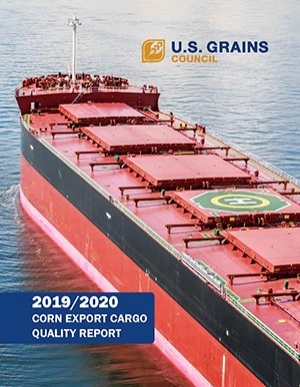
The 2019/2020 U.S. corn crop faced many challenges, including late planting, delayed maturation and late harvests. Even with these challenges, data compiled in the U.S. Grains Council’s (USGC’s) 2019/2020 Corn Export Quality Report indicate the majority of the crop – 71.2 percent of samples tested – still had a test weight at or above the limit for U.S. No. 1 grade corn, indicating good quality and demonstrating the resiliency and reliability of the United States as a global grain supplier.
“Despite often unfavorable growing conditions, U.S. corn, sampled at export elevators – the last point before being transferred to our international customers – met export grades for the U.S. Department of Agriculture’s (USDA’s) Federal Grain Inspection Service (FGIS),” said Reece Cannady, USGC manager of global trade. “More than anything, these results demonstrate how the U.S. grain export system is able to meet contract specifications each and every year.”
Following global social distancing guidelines, the Council is recasting its traditional series of crop quality seminars to include virtual interactions with customers by country and regional staff members and forthcoming webinars hitting highlights in both English and Spanish.
“Corn quality information is vital to foreign buyers and other industry stakeholders as they make decisions about purchase contracts and processing needs for corn for feed, food or industrial use, especially during this uncertain time of COVID-19,” said Darren Armstrong, USGC chairman and farmer from North Carolina.
“This report – along with its companion, the Corn Harvest Quality Report – has always created value for stakeholders, but it is especially important in light of the global pandemic, and we hope it’s comforting to know that end-users can rely on the U.S. to supply a consistent and reputable product.”
The 2019/2020 Corn Export Quality Report is based on 404 export cargo samples collected from corn shipments undergoing federal inspection and grading processes at export terminals. It also provides information on grading, handling and how U.S. corn is moved and controlled through export channels.
The analysis showed average test weight was lower than the 2018/2019 crop at 56.8 pounds per bushel, but still indicating overall good quality and only slightly lower average protein than the 2018/2019 crop and the five-year average, at 8.5 and 8.4 dry basis, respectively. Chemical composition indicated slightly lower starch (72.2 percent dry basis) and the same average oil concentrations in comparison with last year’s crop (4 percent dry basis). Exports had higher average stress cracks and lower average kernel weight, but the same average kernel volume than 2018/2019 and the five-year average. Kernel true density and whole kernels averaged lower, but there was a similar average of horneous endosperm from last year’s to this year’s crop.
All export samples tested below the U.S. Food and Drug Administration (FDA) action level for aflatoxins, below advisory levels for deoxynivalenol (DON) or vomitoxin. For the first year, fumonisin was tested, and 95.3 percent of samples tested below the FDA’s strictest guidance level of five parts per million.
Additionally, average BCFM (Broken Corn and Foreign Material) of 3.1 increased only slightly over the five-year average of 2.9, denoting the blending ability of elevators throughout the country to compensate for BCFM effects from adverse growing conditions.
“This past year’s growing conditions could have yielded greater BCFM issues, but average values were only slightly higher than average,” Cannady said. “This result indicates the U.S. export system was able to meet USDA’s grade standards and meet contract requirements. More than anything, it is a testament to elevator operators around the country for doing a great job in keeping things going during a tough year.”
Rio Tinto has driven performance to achieve 3% YoY CuEq1 growth in the first half of 2026.Chief Executive... Read more
BHP have released its Operational Review for the year ended 30 June 2026.Chief Executive Officer, Brandon... Read more
Bulk carriers carrying elemental sulphur cargoes in the Strait of Hormuz are at significant risk of... Read more
Further to BHP’s announcement in February, BHP, through a wholly owned subsidiary, has executed... Read more
Australia’s Federal Government's fertiliser support package has come under scrutiny as global... Read more
SSAB has once again paused work at the construction site for its new steel mill in Luleå, Sweden... Read more
Trafigura Group Pte Ltd. has announced the issuance of a USD500 million senior Reg S bond with a five... Read more
The National Grain and Feed Association (NGFA) in the USA has welcomed the release of Senate Agriculture... Read more
Anglo American plc, through its 50.1%-owned subsidiary, Anglo American Sur S.A., and Codelco, have announced... Read more
SSAB Americas, The Greenbrier Companies and Alter Trading are partnering on a circular economy project... Read more