









(Posted on 23/04/26)
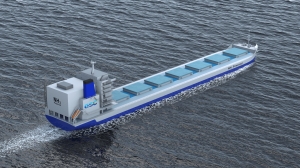
ClassNK has issued an Approval in Principle (AiP) for an Ammonia–Fuelled Panamax Bulk Carrier Equipped with an IMO Type B Independent Fuel Tank developed by Planning and Design Center for Greener Ships.
This marks the world’s first AiP for a ship with Type B tanks installed on the exposed deck. The certification demonstrates its feasibility from regulatory and safety perspectives.
As decarbonisation becomes a major challenge for the shipping industry, ammonia, which emits no CO? during combustion, is expected to be utilized as a zero carbon marine fuel. Traditionally, IMO Type C tanks* have been the mainstream choice for ammonia fueled ships and other alternative fuel ships due to their advantages in productivity and cost. Meanwhile, for the large-capacity fuel tanks required on ammonia-fuelled ships, IMO Type B tanks are gaining recognition as an alternative, offering superior cargo efficiency and outfitting flexibility.
ClassNK has been involved in projects aiming for zero-emission ships using ammonia fuel in terms of safety assessment, and has issued its ‘Guidelines for Ships Using Alternative Fuels’ as a necessary standard to minimize the risks related to ammonia-fueled ships for the ships, crews, and environment by stipulating requirements for installation, controls, and safety devices. Following a review of the ship design based on the above guidelines and the relevant Rules and Guidance for the Survey and Construction of Steel Ships. Upon confirming compliance with the prescribed requirements, ClassNK issued an AiP.
ClassNK will continually strive to contribute to advanced decarbonisation initiatives through safety assessments and more.
* One of the independent tank types defined under the IGC Code, the international code for the construction and equipment of ships carrying liquefied gases such as ammonia and LNG in bulk.
At the initial stage of designing or before the specific target ship to be implemented is decided, the design is examined based on the existing regulations such as international conventions and ship classification rules, and an Approval in Principle (AiP) is issued as proof of conformity with requirements. It also prevents rework of regulatory aspects in the post-process, shortens the examination time at the time of class registration, and can be used as a technical basis for external appeal of the design status. For more information, visit our ?website.
The Maritime Association for Clean Seas (MACS) has published a series of practical guides to enable... Read more
Shanghai has officially become the world’s second-most prominent shipping hub, according to the... Read more
OceanScore, the maritime data and sustainability company helping shipping and ports turn regulatory... Read more
Bulk carrier safety continues to show steady long-term improvement, but the nature of risk facing seafarers... Read more
Following stronger than expected operational performance in dry cargo, reduced costs associated with... Read more
Algoma Central Corporation, a leading provider of marine transportation services, has announced that... Read more
Major maritime, ports and energy companies have been identified by Cydome’s threat-intelligence... Read more
As the global shipping industry faces mounting concerns over future crew availability, Danica Crewing... Read more
Following an attack on a vessel in the Gulf of Oman, IMO has decided to temporarily pause its evacuation... Read more
Leading health and wellness platform OneCare Group is calling on shipping leaders to recognise the immense... Read more