









(Posted on 11/06/26)
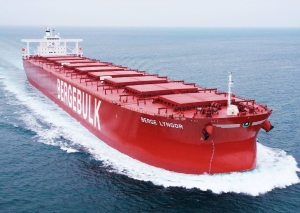
Berge Lyngor, a 206,330 DWT Newcastlemax bulk carrier, owned and operated by Berge Bulk, has been bunkered in Singapore with a B100 bio-blend comprising 50% waste tallow and 50% used cooking oil. The vessel, chartered by BHP, will transport iron ore from Western Australia to China. The tallow-derived biofuel was sourced and supplied by HAMR Energy.
Berge Bulk is one of the world’s leading independent dry bulk owners and has an outstanding record for its reliable, safe and efficient delivery of commodities around the world.
In early 2025, the same vessel completed the world’s first iron ore voyage from Australia to China powered entirely by B100 biofuel, also with BHP.
If waste tallow is proven to be operationally viable, biofuel produced from underutilised livestock by-products has the potential to expand the supply of low-emissions marine fuels.
Biofuels for global shipping today rely heavily on used cooking oil – a feedstock whose availability is approaching its projected limits. Biofuel from waste animal fats presents a promising option to expand the supply of lower-emissions marine fuels.
Using this biofuel blend on this voyage, Berge Lyngor is expected to reduce well-to-wake greenhouse gas emissions by approximately 79% per voyage compared to sailing on very low sulphur fuel oil (VLSFO).
James Marshall, Berge Bulk’s Founder & CEO, says, “Berge Bulk has been gaining experience using biofuel (B30, B50, and B100) on voyages since 2021. Over the past year alone, our biofuel voyages avoided more than 13,000 tonnes of carbon emissions. It’s an important element of our decarbonisation plan alongside efficiency, technology, and carbon capture.”
Duncan Bond, Berge Bulk’s Chief Commercial Officer, says, “Berge Bulk is testing biofuels that are produced, transported, and bunkered within regions of high strategic relevance to dry bulk shipping. While the capesize segment is not yet significantly impacted by current regional regulatory frameworks, we are planning ahead. The scale of transition will be substantial when carbon pricing schemes become more inclusive and globally aligned, and we intend to be ready when that moment comes.”
Paolo Tonon, Berge Bulk’s Technical Director, says, “Two important considerations around biofuels are operational continuity and feedstock compliance. These trials are our structured way of addressing and mitigating those risks, so that when the time comes to scale, our operations are seamless, verified, and compliant.”
HAMR Energy’s Co-Founder, David Stribley, says, “This project shows the huge potential of biofuels to power fleets, reduce emissions and strengthen fuel security by diversifying supplies… The success of this trial is an important step in embedding biofuels from various feedstock sources in the shipping fuel mix.”
EMS-Tech is celebrating the successful delivery of WONTANARA, the first of a new class of high-capacity... Read more
CM Technologies (CMT) has supplied its integrated onboard fuel/oil testing and analysis kits to a fleet... Read more
Superior Industries, Inc., a U.S.-based manufacturer and global supplier of bulk material processing... Read more
NDE Readymix Concrete Ltd., established in 2009, is the largest non-cement ready-mix concrete producer... Read more
German corrosion protection specialist Steelpaint has successfully completed a technical field trial... Read more
Veson Nautical has announced the Veson Platform, a unified, AI-powered experience that brings together... Read more
ABB has announced that it has entered into an agreement to acquire marine automation specialist Hø... Read more
NAVTOR has unveiled the latest iteration of its Digital Logbooks offering, featuring the industry&rsquo... Read more
The maritime industry is facing a rapidly changing fire risk on board vessels as electric vehicles and... Read more
Smart Ship Hub (SSH), the maritime intelligence and data collection platform, has launched one of the... Read more