




(Posted on 07/07/26)
Bulk carriers carrying elemental sulphur cargoes in the Strait of Hormuz are at significant risk of accelerated structural corrosion, with some vessels having remained at anchorage for more than three times the standard cargo protection period, marine consultancy Brookes Bell has warned.
Arron Jackaman, Director of Non-Destructive Testing at Brookes Bell, has urged shipowners, P&I clubs, and hull and machinery insurers to assess the condition of affected dry bulk carriers as soon as possible in order to avoid potential damage and financial loss.
The risk stems from the limited working life of the protective treatment applied to cargo holds before loading, and how far that protection might have already been exceeded on vessels delayed in the Strait.
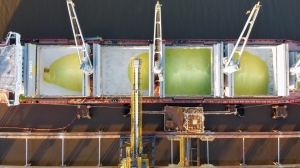
Elemental sulphur is loaded into bulk carrier holds prepared with a limewash hold block coating, designed to act as a barrier between the cargo and the vessel's steel structure. Once loaded, the cargo is dampened with a water mist to provide protection for approximately 20 days, after which the steel is exposed.
Once moisture and sulphur come into contact with unprotected steel, an acidic environment can develop, promoting the formation of iron sulphide corrosion products and driving rapid, localised pitting corrosion at rates far exceeding normal seawater exposure.
With some vessels in the Strait of Hormuz having remained at anchorage for upwards of 60 days, Jackaman noted that this protection period has been significantly exceeded and has warned about the risk of further damage to bulk carriers stuck in the region.
"The hold block for carrying sulphur cargoes has a standard working life of around 20 days. Where vessels have been at anchorage for two months or more, that protection has long since been exhausted. The corrosion that can develop once exposed steel is subjected to prolonged contact with sulphur and moisture is orders of magnitude more aggressive than normal seawater exposure," said Jackaman.
Brookes Bell noted that it has been investigating sulphur cargo claims for vessels that had managed to exit the Strait of Hormuz since February. It noted that it has documented pitting depths in unprotected steel of up to 5 mm forming in approximately 50 days, with some cases even recording wastage of up to 7 mm. The standard corrosion rate in a seawater environment is 0.2 mm per year.
"Sulphur corrosion often appears visually more severe than it actually is. Localised pitting tends to concentrate at points where grab discharge equipment has broken the coating barrier, and on cargo hold tank top plating, which is left uncoated by design. Without correct measurements and quantitative assessment, there is a significant risk that steel within class limits is condemned unnecessarily," Jackaman explained.
Under Common Structural Rules, bulk carrier cargo hold structures such as tank top plating, bulkhead stools and sloping hopper plating incorporate a sacrificial corrosion allowance of 5.5mm. Visual assessment alone does not account for this margin, and Jackaman has warned that claims based on visual severity routinely overstate the repair strategy and structural renewal that is required.
"Wholesale steel renewal can cost around 10 times more than targeted localised repair. If the extent of repair is being decided on the basis of what the damage looks like rather than what the measurements show, then owners, charterers, and their insurers can end up paying significantly more than the structural condition requires," said Jackaman.
Further to BHP’s announcement in February, BHP, through a wholly owned subsidiary, has executed... Read more
Australia’s Federal Government's fertiliser support package has come under scrutiny as global... Read more
SSAB has once again paused work at the construction site for its new steel mill in Luleå, Sweden... Read more
Trafigura Group Pte Ltd. has announced the issuance of a USD500 million senior Reg S bond with a five... Read more
The National Grain and Feed Association (NGFA) in the USA has welcomed the release of Senate Agriculture... Read more
Anglo American plc, through its 50.1%-owned subsidiary, Anglo American Sur S.A., and Codelco, have announced... Read more
SSAB Americas, The Greenbrier Companies and Alter Trading are partnering on a circular economy project... Read more
The IFA Innovation Hub, a platform of the International Fertilizer Association (IFA), has released Fertilizer... Read more
BHP, the world’s largest mining company, has announced that Canadian Pacific Kansas City (CPKC... Read more
The U.S. Grains & BioProducts Council (USGBC) and United Sorghum Checkoff Programme (USCP) have... Read more