








(Posted on 17/04/25)
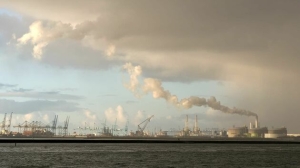
Greenhouse gas emissions at companies in the port decreased by 1.7 Mton (8%) in 2024 compared to 2023. This time, unregistered emissions and other greenhouse gas emissions were also included. This brings the total greenhouse gas emissions from companies in the port to 19.2 Mton in 2024.
The reduction is due to lower industrial production and the increased generation of sustainable energy in the Netherlands. Actions such as the closure of coal plants, the launch of Porthos and the use of renewable energy and raw materials in industrial production are expected to result in a further decline. These are expected later this decade.
All together, the five power plants in the port emitted 0.7 Mton (12%) fewer greenhouse gases in 2024 than in 2023. This is primarily due to a decline in electricity generation from coal. In the Netherlands, emissions from the electricity sector decreased by 3% thanks to continued growth in electricity generation from wind and solar power. Industry in the port of Rotterdam emitted 1 Mton (7%) fewer greenhouse gases in 2024 than in 2023.
As in the previous year, production in the chemical industry did not recover in 2024, and emissions continued to decline by 0.1 Mton (2%). The supply and processing of crude oil in the port declined in 2024, resulting in 0.5 Mton (6%) fewer emissions at refineries. In the other sectors in the port, emissions in 2024 were 0.4 Mton (29%) lower than in 2023, as the waste incineration plant could only be restarted in October 2024 following a fire the previous year.
The total emissions of 19.2 Mton in the port industrial complex comprises the CO2 emissions from the 42 ETS companies (18.1 Mton CO2 emissions), 22 non-ETS companies subject to registration (0.23 Mton CO2 emissions), unregistered emissions from companies in the port (0.75 Mton CO2 emissions) and the other greenhouse gas emissions from companies in the port (0.12 Mton CO2 equivalents). This year, the Port of Rotterdam Authority has retroactively included other greenhouse gases and CO2 emissions from unregistered emissions from companies for the first time. For the unregistered emissions, the Port of Rotterdam Authority relies on an estimate provided by the research and consultancy firm CE Delft.
CE Delft recently advised the Port of Rotterdam Authority on the calculation of greenhouse gas emissions in the port, covering both companies based in the port and transport linked to the port. The study has provided several recommendations for improving the mapping of greenhouse gas emissions in the port. These have now been incorporated into the reporting of emissions from companies in the port. The 2025 annual report will also include recommendations regarding transport. For more information on monitoring the port’s greenhouse gas emissions, see our website (in Dutch).
In the first half of 2026, Port of Antwerp-Bruges handled 133.9 million tonnes of maritime cargo, a... Read more
PD Ports, one of the UK’s major port and logistics businesses, announced today that Paul Foreman... Read more
The Port of San Diego Board of Port Commissioners has approved an Option to Lease Agreement and authorised... Read more
AD Ports Group, an Abu Dhabi based, leading global enabler of integrated trade, industry and logistics... Read more
The Hamburg Port Authority (HPA) and SPG Qingdao Port Group have signed a Port Partnership Agreement... Read more
The Cook Labor Government in Australia has welcomed the award of a dredging contract to Jan De Nul ... Read more
A parliamentary letter in the Netherlands on the selection of a site for the construction of two new... Read more
The long-term safety cooperation between ESL Shipping and the port of SSAB’s Raahe site is visible... Read more
The Port of Liverpool is experiencing a surge in demand from fertiliser importers as continued uncertainty... Read more
PD Ports has further strengthened its bulk handling capability at Teesport with the arrival of... Read more